
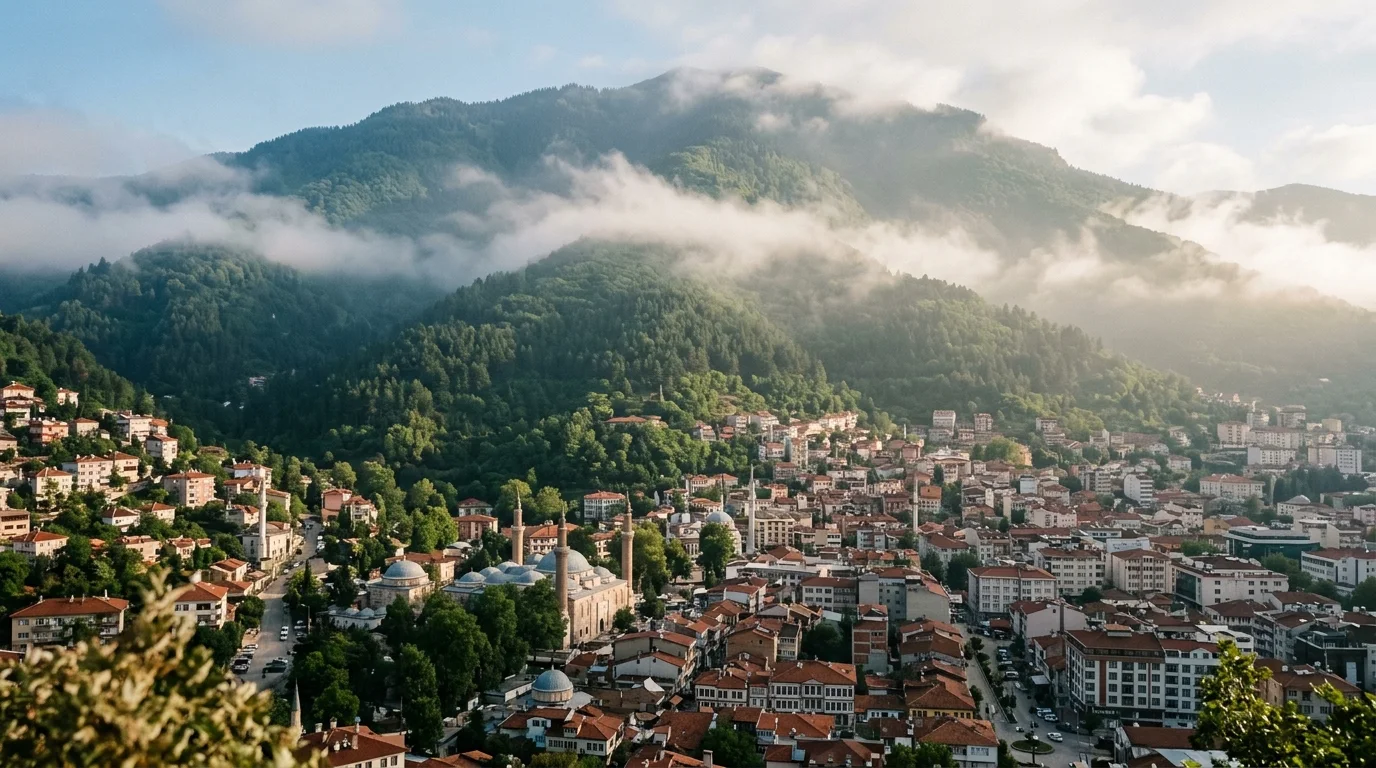
Overview
Bursa is a province in Turkey’s Marmara region, centred on a large city in the Southern Marmara area about 20 km inland from the sea. The city had 2,161,990 residents in 2021, with over a million more in the wider metropolitan area. It was the first capital of the Ottoman Empire and an end point of the Silk Road, and it was added to the UNESCO World Heritage List in 2014 together with the nearby village of Cumalıkızık. It is also the gateway to the forests and ski slopes of Mount Uludağ.
The settlement of Prusa was founded in 202 BC and named after King Prusias of Bithynia. The Romans took the area in 74 BC, and the thermal springs at Çekirge made it a resort. Osman captured surrounding towns but not the citadel, and his son Orhan took the city in 1326 and made it the Ottoman capital. The city prospered through silk, and a magnitude 7.0 earthquake followed by fire in 1855 caused major damage.
Best time to visit
Summers are hot and humid with little breeze and occasional thunderstorms. Winters are chilly, cloudy and wet, with daytime temperatures usually between 5 and 10 degrees Celsius. Snow melts quickly in town but accumulates on Uludağ, which is the base for skiing. Strong southwesterly gales called lodos occur in winter. Spring is mild and wet, but much of the rain falls on the mountain, leaving the city relatively dry. The source gives no single recommended season for the city, so choose by activity: winter for skiing, and spring or autumn for walking the old districts.
How to get there
- From Istanbul by road: Take the E80/O5 east, crossing the Osmangazi Bridge. From Ankara, take the D200/E90 via Eskişehir.
- By intercity bus: Journeys take about 2 hours 10 minutes from Istanbul non-stop, 5 hours 15 minutes from Ankara, about 4 hours from İzmir, about 4 hours 15 minutes from Çanakkale and about 9 hours from Antalya. The main bus terminal is about 10 km north of the centre on the D575, linked to the centre by town buses and a tram.
- By ferry from Istanbul: Services run to Mudanya and Güzelyalı, both about 20 km north of Bursa. The crossing takes just under two hours, with İDO sailing from Kabataş, Kadıköy and Yenikapı and BUDO from Eminönü. Total travel time is about 3 hours, and shuttle buses or dolmuşes connect the piers with the city.
- Via airports: From Sabiha Gökçen Airport, a bus runs about hourly to Bursa Otogar in roughly 90 minutes. From Istanbul Airport, a BBBus service also runs directly to Bursa’s bus terminal. Yenişehir Airport, 43 km east of the city, has limited flights.
- Rail: Bursa has no railway; buses connect with high-speed YHT trains at Eskişehir, about two hours away.
Main places to see
Ulu Camii (Grand Mosque). Completed in 1399 and known for its calligraphic panels and central fountain. It was rebuilt after the 1855 earthquake in a Seljuk-influenced design.
Green Mosque (Yeşil Camii). Built between 1419 and 1424, with green and blue tilework and the tomb of Mehmed I Çelebi. Its madrasah now houses the Turkish and Islamic Art Museum.
Muradiye Complex. A mosque dating from 1426 with eight mausoleums of early Ottoman nobles and a calligraphy museum.
Koza Han (Silk Bazaar). A caravanserai built in 1490, now lined with shops and cafés. Nearby, the covered Grand Bazaar was rebuilt after a fire in 1958.
Tophane and the citadel. The area has the clock tower, the tombs of Osman Gazi and Orhan Gazi, the Imperial Gate and the old walls with views over the city.
Cumalıkızık. A village about 10 km east, founded roughly 700 years ago, with half-timbered houses, most still inhabited.
Other sights. The Irgandı Bridge (a footbridge from 1442 lined with small shops), the Yeni and Eski hamams fed by geothermal springs in Çekirge, and museums including the Karagöz Museum, the Archaeology Museum and the Atatürk House. Most branches of Bursa Müze are closed on Mondays. The İnkaya Plane Tree, about 600 years old, has a café beneath it.
Getting around
- Bursaray (metro) runs east to west. Useful stops include Şehreküstü for the old town and market, and Kestel at the east end.
- Burtram (tram) runs 07:00 to 23:00 on three lines, including a heritage metre-gauge line (T3) and a line from the centre to the main bus station (T2).
- Bursakart is a rechargeable card for buses, metro and tram. Cash is not accepted on some buses.
- Buses and dolmuşes form an extensive network; dolmuşes are shared cars with a roof sign, and basic Turkish helps.
- Teleferik (cable car) runs from the north of the city up Uludağ in about 15 minutes. It is too cramped for ski equipment.
- Driving: Roadside parking is scarce and charged.
Practical tips for visitors
- Bursa is regarded as a safe city; take normal care with traffic and valuables.
- Local food associations include döner kebap origins, İskender kebap, cantık pide and candied chestnuts.
- 5G is available from the major Turkish carriers in the city.
- Many mosques are active places of worship, so dress modestly and plan around prayer times.
- Confirm opening hours of museums before you visit, as some details can change.
- Plate code
- 16
- Best season
- Spring to autumn for the city; winter for skiing on Uludağ
