
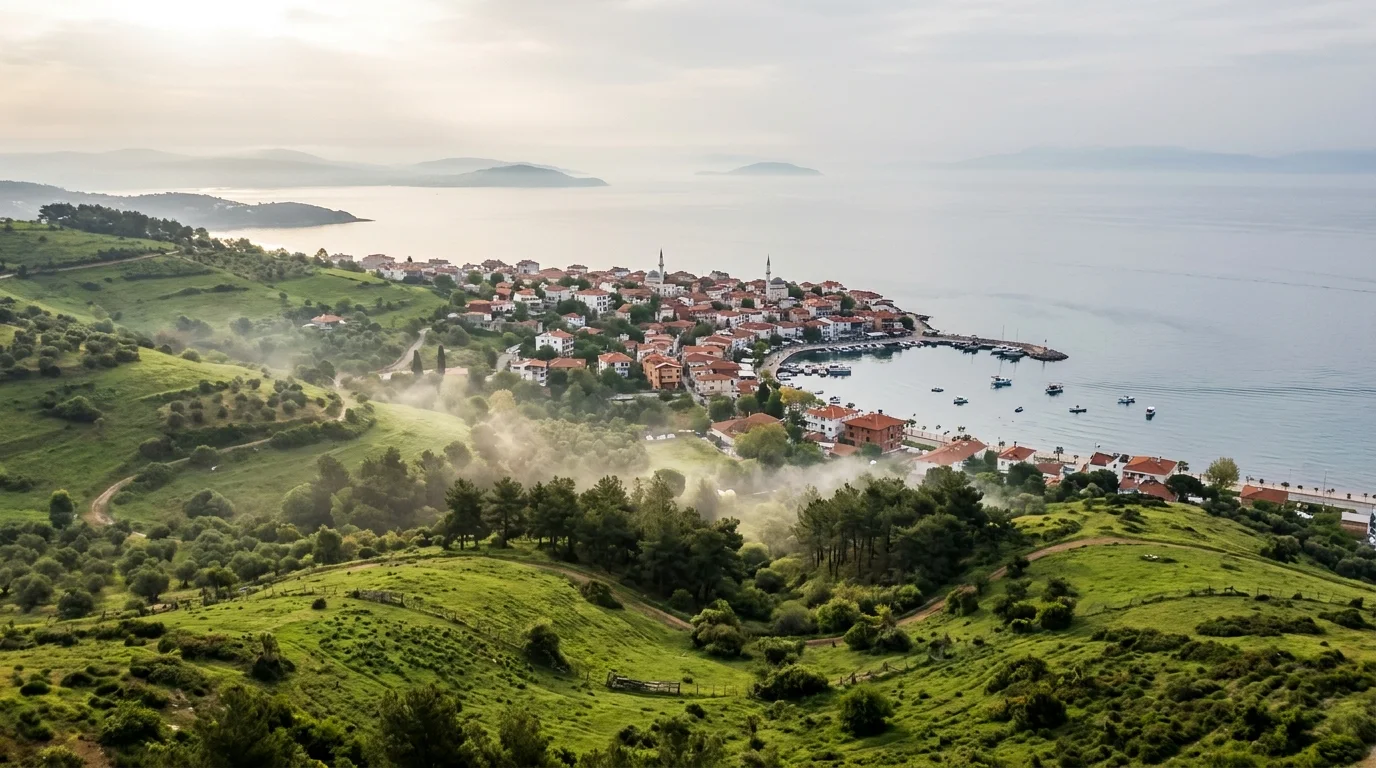
Overview
Bilecik is a province in north-western Turkey (plate code 11). Wikipedia gives its area as 4,179 km2 and its population as 228,673 in 2022 (a table in the article gives 218,717 for 2020). There are eight districts: Bilecik (the capital district), Bozüyük, Gölpazarı, İnhisar, Osmaneli, Pazaryeri, Söğüt and Yenipazar. The province borders Bursa to the west, Kocaeli and Sakarya to the north, Bolu to the east, Eskişehir to the south-east and Kütahya to the south.
Most of the province lies in the Marmara Region, but parts of Gölpazarı, Söğüt, İnhisar and Yenipazar fall in the Black Sea Region, small parts of Bozüyük and Söğüt are in Central Anatolia, and a small south-western part of Bozüyük is in the Aegean Region. The article describes the province as dominated by hills and deep valleys, including the western end of the Anatolian Plateau, with the Sakarya River and the Karasu as the important rivers.
The region was inhabited as early as 3000 BC, according to Wikipedia, and was controlled successively by the Hittites, Phrygians, Lydians, Persians, Romans and Byzantines. Söğüt is where the Kayı tribe under Osman Gazi began the Ottoman Beylik. The official culture and tourism site records Söğüt as known as the first capital of the Ottoman Beylik and dates it to 1231, when Ertuğrul Gazi took it. The city article adds that, according to the account of Aşıkpaşazade, Osman I captured the Bilecik fortress in 1299 to 1300, although the identification of the earlier name Belokome with Bilecik is uncertain. Prehistoric sites include the Bahçelievler settlement (Late Neolithic) and the Çiftlik Alanı mound (Early Bronze Age).
The city of Bilecik is described as known for its many restored Turkish houses and as increasingly visited by tourists. It is a member of the European Association of Historic Towns and Regions, and has about 74,457 residents (2021, with 71,594 given for 2025 in the same article’s infobox).
Best time to visit
The sources do not state a recommended season. The city article gives the climate as hot-summer Mediterranean (Köppen Csa) or temperate oceanic, with cold winters and snow frequently falling from December to March and hot, dry summers. It gives a record high of 41.0 °C (13 July 2000) and a record low of -16.0 °C (13 January 1950). Average annual precipitation is about 482.1 mm, with about 20.9 snowy days a year and about 2,337 hours of sunshine.
For events, the official site lists items with dates in 2026: the Gölpazarı Cherry Festival (8 July), the International Hacı Bektaş Veli commemoration (18 August), a Ahilik Week and Ertuğrul Gazi commemoration with Yörük festivities (28 September), the Çukurören Pepper Festival (23 October) and the İnhisar Pomegranate Festival (3 November). The page notes these may be posting dates rather than event dates, so verify them.
How to get there
The sources give limited transport detail.
- By rail and road: Wikipedia’s province article shows a high-speed train at Bilecik and links the province to the Ankara to Istanbul high-speed railway. The city article includes a photograph of Bilecik Railway Station.
- Osmaneli: The official site says Osmaneli lies on the Istanbul to Eskişehir highway and the Istanbul to Eskişehir to Ankara railway, and connects by road via İznik to Bursa and Yalova. Distances from Osmaneli are Bilecik 34 km, Eskişehir 106 km, Adapazarı 72 km, Kocaeli 110 km, Istanbul 202 km and Bursa 104 km.
- Söğüt: about 30 km south-east of Bilecik city, according to the city article.
- Wikivoyage had no page for Bilecik at the address fetched, and the official site’s directions page was not readable, so no airport or bus timings are stated.
Main places to see
Söğüt. Named as the first capital of the Ottoman Beylik. Wikipedia lists the Söğüt Ethnographical Museum, the Osman Gazi and Orhan Gazi mosques, the Şeyh Edebali and Mal Hatun mausoleums and the Dursun Fakih tomb.
Bilecik town centre. The restored Turkish houses of Bilecik town, the Clock Tower in the historic centre, and the tomb of Sheikh Edebali near the Orhan Gazi Mosque.
Köprülü Mehmet Pasha Mosque and Köprülü Caravanserai. Listed among the sights in the province article, together with the Rüstem Pasha Mosque and the Gülalan Pavilion.
Kaplıkaya tombs. Named in the province article without description.
Gölpazarı. The official site says Gazi Mihal Bey’s tomb is in the courtyard of the Gazi Mihal Bey Mosque.
Pazaryeri. Known in Byzantine times as Armeno Kastron, according to the official site, which says Osman Bey used the Ermeni Derbendi route through the area.
Osmaneli. Joined the Ottoman state in 1308 under Osman Gazi and became a district of Bilecik in 1926.
Digital history museum. The official site reports the opening of a digital museum on the history from beylik to empire, in a news item dated 3 September 2026.
Getting around
The sources do not describe local public transport. The province is made up of eight districts spread across hills and valleys, and the distances quoted from Osmaneli (34 km to Bilecik) suggest that reaching Söğüt, Gölpazarı and other district towns involves road travel. The Bilecik city centre is described as having restored historic houses, but the sources do not say whether it can be explored on foot. Check local options in advance.
Practical tips for visitors
- Plan around local festivals only after confirming dates with the official site, since the listed dates may be posting dates.
- Expect cold, snowy weather between December and March, according to the city article.
- The province has many small sites outside the city (Söğüt, Gölpazarı, Pazaryeri), each with its own history, so ask the provincial culture and tourism directorate which are open.
- The official site’s pages on how to get there and where to stay were not readable in the fetched text, so confirm transport and lodging with the provincial culture and tourism directorate.
Source notes
The Wikivoyage page for Bilecik did not exist at the address fetched. The city article gives two population figures (74,457 for 2021 and 71,594 for 2025). Regional membership is split across four regions according to Wikipedia.
- Plate code
- 11
