
Overview
Kütahya is a province in western Turkey (plate code 43). Wikipedia places it in the Aegean Region, while Wikivoyage describes the city as being in Central Anatolia, so the two sources differ on the regional label. Wikipedia gives the area as 11,634 km2 and the population as 580,701 in 2022; Wikivoyage gives a figure of 578,640 for 2022 and describes it as the population of the city, although the numbers are close to the provincial total, so treat the city figure with caution.
The province has 13 districts: Altıntaş, Aslanapa, Çavdarhisar, Domaniç, Dumlupınar, Emet, Gediz, Hisarcık, Kütahya, Pazarlar, Şaphane, Simav and Tavşanlı. It borders Bursa, Bilecik, Eskişehir, Afyon, Uşak, Manisa and Balıkesir.
Wikipedia says the history of Kütahya extends back to about 3000 BC, with ancient names such as Kotiaeon and Cotiaeum. Hittite domination began around 1320 BC, Phrygians settled the area, and Alexander the Great established control in 334 BC, followed by the Romans in 133 BC. Seljuk Turks captured the city in 1078, and it became a sanjak capital under the Ottomans in 1429.
The province is associated with ceramics and tiles. Wikipedia says Kütahya was the second Ottoman production centre after Iznik and became the only centre in the field after Iznik’s fine porcelain declined in the 18th century. Wikivoyage describes the city as industrial but with a well-preserved old quarter, at 970 m in a mountain valley where industrial smog gets trapped. It adds that in 1514 the Ottomans brought artisans from Tabriz who established tile workshops here and in Iznik. Local foods named by Wikipedia include erişte (homemade pasta), bulgur, tarhana, cimcik, haşhaşlı pide and gözleme.
Best time to visit
No source states a best season. Wikivoyage describes the climate: winters are cold with temperatures routinely below freezing, and summers are dry with temperatures approaching 35 degrees Celsius. It does not name an ideal period. Anyone choosing between the seasons should weigh those extremes, and may find the intermediate months more moderate, but this is an inference rather than a sourced recommendation.
The official provincial tourism site does not give climate information in the version fetched, although it mentions a film festival at Aizanoi and promotional films about tile-making, so check current event listings.
How to get there
- By bus: Wikivoyage lists about 6 hours from Istanbul, 5 hours from Izmir, 7 hours from Antalya and about 4 hours 15 minutes from Ankara. It suggests that from Ankara it may be easier to take the high-speed YHT train to Eskişehir and then a frequent bus of about one hour. The bus station is 4 km northeast of the centre, with frequent minibuses taking about 15 minutes, usually covered by your intercity ticket.
- By train: An overnight service called Izmir Mavi runs from Ankara and from Izmir, and Ege Ekspresi runs from Izmir in about 9.5 hours. Regional trains from Eskişehir take 70 minutes. The station is 1 km east of the centre.
- By car: From Eskişehir, take the D230/D650 south through canyons on a divided highway. The D650 continues to Antalya. From Izmir, take the E96/D300 toward Uşak, then the D595/D240.
- By air: Zafer Airport (KZR) is 45 km southeast of the city, with flights from Istanbul according to Wikivoyage. Airport buses run to Kütahya about 25 minutes after each arrival.
Main places to see
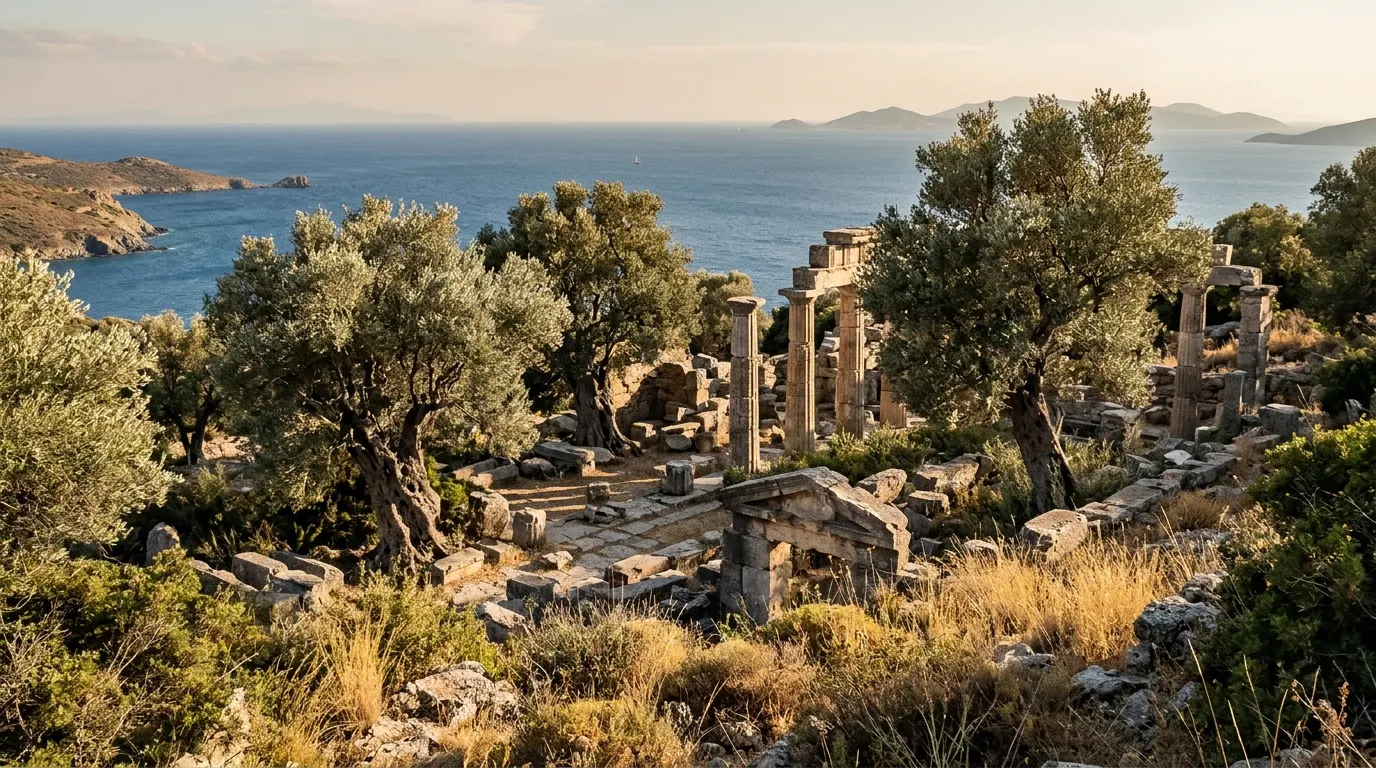
Aizanoi. The ancient city in Çavdarhisar district, about 60 km southwest of Kütahya city, is known for its Temple of Zeus. Wikipedia names it as the main sight of the province, and Wikivoyage calls it the most popular day trip. The official site mentions Aizanoi in the title of a short film festival.
Germiyan Street. A cobbled alley of restored Ottoman-era mansions, described by Wikivoyage as the best-preserved part of the old town.
Mosques. The Green Mosque (Yeşil Cami) was built in 1905 and has rich tilework inside. The Great Mosque (Ulu Cami) was begun under Beyazıt I and completed in 1401, with tiles around the mihrab. The Dönenler Mosque was built in the 14th century as a lodge for the Mevlevi order. The Kurşunlu Mosque dates from 1377 and was restored in 2018, according to Wikivoyage.
Museums. The Archaeology Museum is in a madrasah built in 1314, with a marble sarcophagus from Aizanoi. The Çini Museum, a tile museum, is in the former soup kitchen of the Great Mosque. Wikivoyage also lists the Hungarian House, where Lajos Kossuth lived in 1850 to 1851, and a Geology Museum in an ancient hamam.
Kütahya Castle. Open at all hours, of Byzantine origin with a 15th-century upgrade, per Wikivoyage.
Tile Mosque (Çinili Cami). Built in 1973 with blue and turquoise tiles; Wikivoyage says it was closed for restoration with no set completion date.
Getting around
Wikivoyage advises walking, since the sights are central, and says dolmuş minibuses and city buses are rarely needed. The main landmarks are the clock tower and the tiled “Vazo” monument on Zafer Meydanı (Victory Square). Aizanoi is outside the city and is usually visited as a day trip.
For the Tile Bazaar (Çiniciler Çarşısı), Wikivoyage says it is 5 km out on the Eskişehir road, so you will need a taxi or dolmuş.
Practical tips for visitors
- Wikivoyage says tiles come in three grades: basic tourist souvenirs, factory-made work by apprentices, and signed master-made pieces. Haggling is suggested for the basic souvenirs.
- Be wary of “antiques”. Wikivoyage notes that most tiles are modern and that genuine antiquities cannot be legally exported.
- Consider the weight of tiles in your luggage.
- The area is geothermal, and hot springs and hamams are listed by Wikivoyage as activities.
- Wikivoyage reports 4G coverage in the city; its information dates from around 2022, so check hours and closures.
- The official provincial site is available in Turkish, English and German and publishes information on tourism rentals and accommodation regulations.
- Plate code
- 43
