
Overview
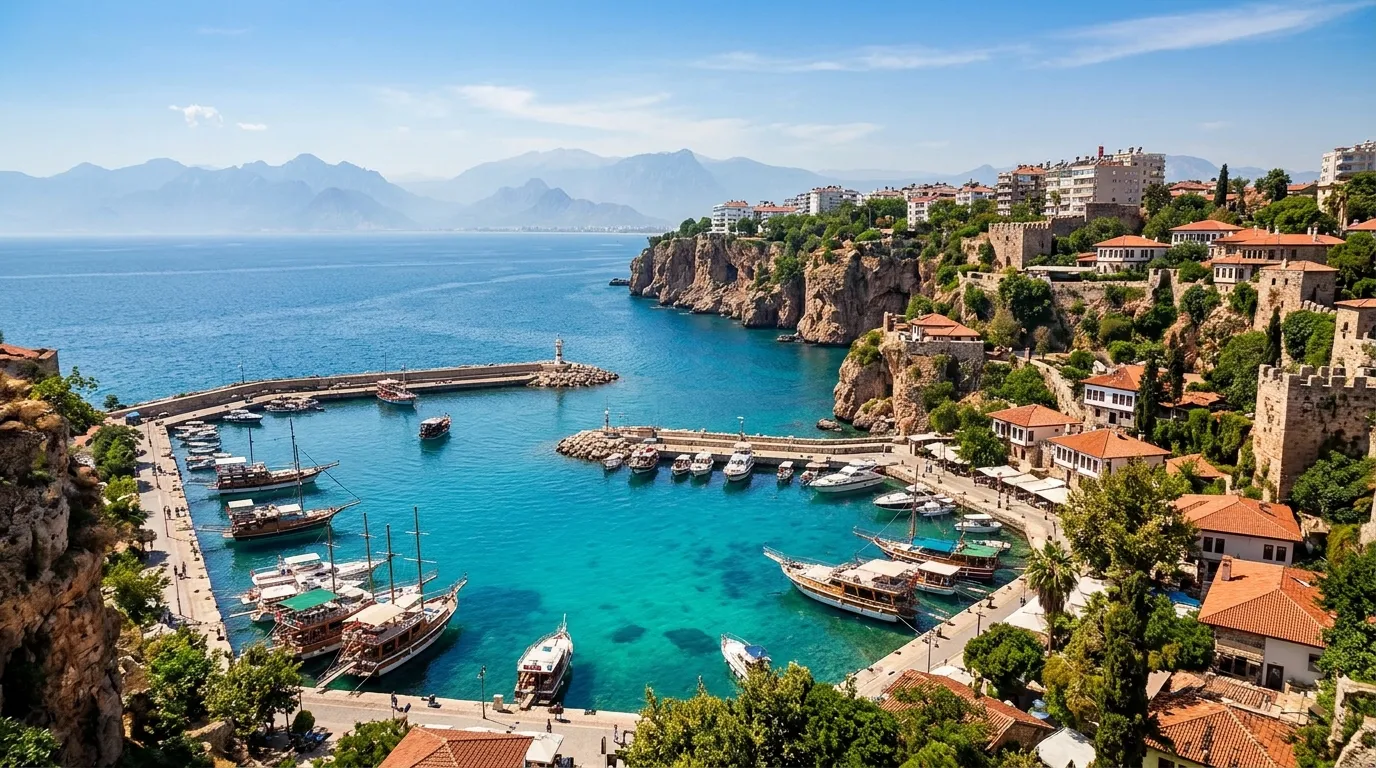
Antalya is a province on Turkey’s Mediterranean coast, and its city combines a historic old town, Kaleiçi, with beaches, waterfalls and several Roman-era sites in the region. The city is the base for visiting ancient Perge and Aspendos, and Termessos lies in the Taurus Mountains. Antalya Airport is a major international gateway, and the old harbour offers boat trips and views over Kaleiçi.
Best time to visit
Antalya has a Mediterranean climate. Summers are hot, sunny, humid and essentially rainless, with days averaging 30 to 35 degrees Celsius and sometimes exceeding 40 degrees. Winters are mostly mild but bring storms, heavy downpours and strong winds. April to May and October to November are considered the suitable months for sightseeing, and the sea stays warm late into autumn.
How to get there
- By air: Antalya Airport (AYT) has two terminals about 1.6 km apart, linked by a free shuttle or walkway. Terminal 1 handles domestic flights and Terminal 2 handles international ones. Domestic flights run daily from Istanbul, Ankara, İzmir, Adana, Samsun, Diyarbakır and Gaziantep. Bus route 600 links both airport terminals with the Otogar every 30 minutes from 07:00 to 00:00, with night runs (600G). Route 800 runs from both terminals to the Lara resort strip and Sarısu.
- By bus: The Antalya Terminal (Otogar) is about 6 km northwest of the centre. Buses from Istanbul take roughly 12 hours, and journey times are about 9 hours from Ankara, 6 from İzmir, 11 from Adana and 6 from Konya. A faster option is the YHT train to Konya with bus connections onward.
- By road: From Istanbul the drive takes about 8.5 hours, using the O7/O5/O22 south past Bursa, then the D200 and D650 via Kütahya and Afyon.
- By sea: Port Akdeniz has a cruise terminal.
Main places to see
Hadrian’s Gate (Üçkapılar). Built around 130 AD for Emperor Hadrian’s visit. It was bricked up within the city walls and rediscovered when the walls crumbled in the 1950s.
Yivli Minare Mosque (Fluted Minaret). A six-domed mosque begun under Seljuk rule in 1230 and rebuilt in 1373 by the Hamidids. The minaret is 38 m tall.
Hıdırlık Tower. Built by the Romans in the 2nd century AD as a bastion and lighthouse, and open 24 hours.
Antalya Museum. One of Turkey’s large museums, with about 5,000 items on display covering Mediterranean and Pamphylian history, and around 25,000 more in storage. Hours are April to September daily 08:30 to 20:00, and October to March Tuesday to Sunday 08:30 to 18:00.
Düden Waterfalls. At the Lower Falls on Lara Caddesi the Düden River drops about 40 m into the sea. The Upper Falls, where the river emerges from karstic tunnels, drop about 20 m.
Perge. A Roman-era city at its height in the 2nd and 3rd centuries AD, with a colonnaded agora, theatre, stadium, a temple to Artemis and two churches. It is open daily 08:00 to 19:30.
Aspendos. About 40 km east near Serik, with a well-preserved amphitheatre seating around 7,000, a 2 km aqueduct, a stadium, baths, a basilica and the Eurymedon Bridge. It is open daily 08:00 to 17:00.
Other Kaleiçi sights. The Dervish Lodge Museum, the clock tower, Karatay Medresi (built 1250), Atatürk House Museum and the Ethnographic Museum. The Şehzade Korkut Mosque (Broken Minaret) began as a 2nd-century Roman temple and reopened in 2021 after reconstruction. Termessos, a ruined ancient city above the Taurus Mountain forests, is a further excursion.
Getting around
- Tram (AntRay): T1 runs from Fatih in the north through the Otogar, İsmetpaşa and Meydan to Yonca Kavşak, with trams every 15 minutes from 06:00 to 00:00. T2 is a heritage line using 1950s and 1960s cars donated by Nuremberg in 1999, running near the coast from the Museum east to Cumhuriyet and south through the Old Town. T3 opened in 2021 and runs from Varsak through Kepez to the Museum.
- Bus: Over a dozen city lines serve the Otogar. KL08 links the western beach with the eastern Düden falls via the centre.
- Payment: Tram and bus fares can be paid by contactless credit card or with an Antalyakart, available at tram kiosks, the airport and the bus terminal.
- Taxis: Stands are throughout the city, and BiTaksi and iTaksi allow online booking. Taxis are recommended for Lara, which is far from the centre.
- On foot: The city centre is walkable.
Practical tips for visitors
- Take standard precautions: watch traffic, drink water and use sun protection, secure valuables and avoid drunks. Stray dogs are present.
- 4G is available from all Turkish carriers and extends along the resort strip; 5G is limited. Free Wi-Fi is found in public squares and cafés.
- Local specialities include Antalya-style piyaz (bean salad) and çiğ köfte.
- The cable car to Tünek Tepe, a 618 m hilltop with city views, collapsed in April 2024 and was closed; the hill can be reached by car or on foot.
- Services are held in English, Russian and Turkish at Saint Paul Union Church in Kaleiçi.
- Several opening hours come from regional listings with dead links, so verify times before visiting.
- Plate code
- 07
- Best season
- April to May and October to November
