
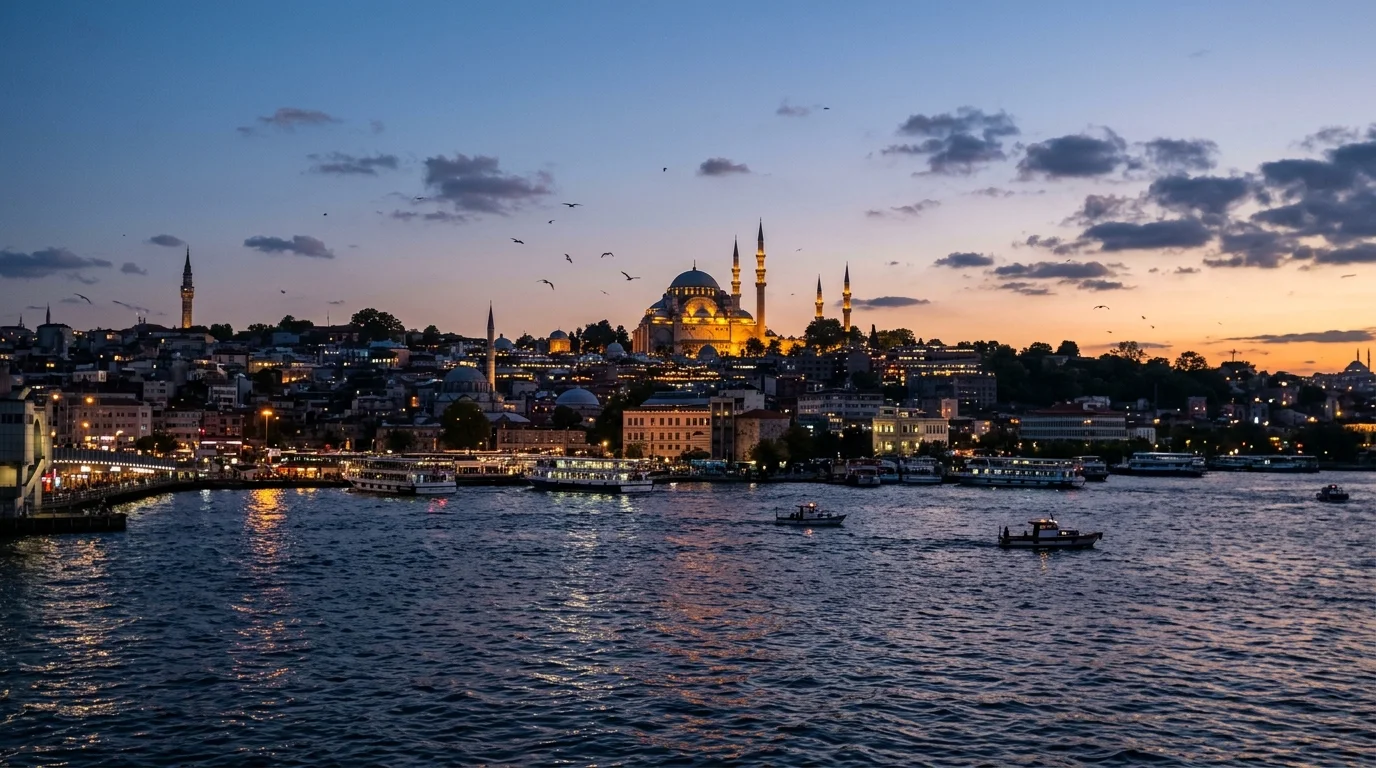
Overview
Istanbul is a province in the Marmara region of Turkey (plate code 34) whose city straddles the Bosphorus, with one part on the European side and one on the Asian side. Most of the major historical monuments sit on the walled Historical Peninsula, the former Constantinople, around the Sultanahmet district. Visitors usually combine these monuments with the Galata and Beyoğlu districts, Bosphorus ferry rides and a day on the Princes’ Islands.
The Historic Areas of Istanbul were added to the UNESCO World Heritage List in 1985, and the listing covers four zones: the Archaeological Park at the tip of the peninsula, the Süleymaniye quarter, the Zeyrek quarter and the zone of the ramparts. Listed monuments include Topkapı Palace, Hagia Sophia, the Sultan Ahmed Mosque, Hagia Irene, the Süleymaniye Mosque and the walls of Constantinople.
Best time to visit
Istanbul has an oceanic climate with Mediterranean influences, so it is cooler and wetter than many visitors expect. Summers are warm and mostly sunny, with a northeasterly wind that keeps temperatures in check, although humidity can be high. Winters are chilly, damp and often windy, with frequent drizzle and occasional snow. Microclimates mean rain can fall in one part of the city while another stays dry.
Late May to early June and late September to early October are generally the most pleasant periods for walking between sights.
How to get there
- Istanbul Airport (IST) lies about 30 km northwest of the city on the European side. Metro line M11 connects it to the city, and buses and taxis are also available. The airport metro runs roughly from 06:15 to 00:15.
- Sabiha Gökçen Airport (SAW) is about 30 km east of the centre, on the Asian side. Metro line M4 runs to Kadıköy in about an hour, and Havabüs buses serve Taksim, Kadıköy and other points.
- Trains: High-speed YHT trains from Ankara, Konya, Eskişehir and Sivas terminate at Söğütlüçeşme on the Asian side. Trains from Europe, including the Balkan Express from Sofia, terminate at Halkalı in the west, from where the Marmaray cross-city line reaches the centre in about an hour. The historic Sirkeci and Haydarpaşa stations no longer receive mainline trains.
- Buses: Most intercity coaches use the Esenler Terminal on the European side; Harem is the main hub on the Asian side.
- Sea: Cruise ships dock at Galataport.
- Driving: Traffic is heavy and signage is limited. Three bridges and a tunnel link the two sides, and all require electronic toll stickers (HGS) rather than cash.
Main places to see
Hagia Sophia. The current building was constructed under the Byzantine emperor Justinian I between 532 and 537 as a Christian basilica and cathedral of Constantinople. Its ribbed dome is about 32.7 to 33.5 m across, with an interior height of about 55.6 m. It became a mosque after the Ottoman conquest in 1453, a museum in 1935, and was reclassified as a mosque in 2020.
Sultan Ahmed Mosque (Blue Mosque). Built between 1609 and 1617 under Ahmed I by the architect Sedefkar Mehmed Agha, a student of Mimar Sinan, it has six minarets. It is called the Blue Mosque because its interior is covered in İznik tiles and painted motifs, mostly in blue. It remains an active place of worship, and it reopened in April 2023 after a restoration that began in 2018.
Topkapı Palace. Mehmed the Conqueror ordered the palace, begun in 1459, six years after the conquest of Constantinople. It served as the administrative centre of the Ottoman Empire and the sultans’ main residence until the move to Dolmabahçe Palace in the mid-19th century. It became a museum by a decree of 3 April 1924. It is organised around successive courtyards, the Harem and the Imperial Treasury, where the Spoonmaker’s Diamond and the Topkapı Dagger are displayed.
Galata Bridge and Galata. The bridge spans the Golden Horn, and Galata was once a colony for European merchants. The funicular known as Tünel, dating to 1875, climbs from Karaköy to İstiklal Avenue.
İstiklal Avenue and Taksim Square. This is the heart of Beyoğlu, known for shops, cafés and a vintage tram line.
Maiden’s Tower. A landmark on the Asian side of the Bosphorus.
Princes’ Islands. Car-free islands in the Sea of Marmara, known for wooden mansions and pine forests.
Eyüpsultan and Balat. Eyüpsultan is an Ottoman-era Islamic heritage area, while Balat is known for colourful houses and Christian heritage.
Getting around
- İstanbulkart: A rechargeable smart card that works on buses, trams, metro, suburban trains and ferries; you touch it on entry. It can be bought and topped up at machines and many kiosks. A non-personalised card does not qualify for transfer discounts or Marmaray refunds.
- Metro: The network is modern and clean, but stations are often far apart and transfers usually mean exiting and re-entering. Line M2 links Yenikapı, Taksim and Levent.
- Trams: T1 is the most useful for visitors, linking Kabataş, the Old City and Zeytinburnu. T5 runs along the Golden Horn.
- Ferries: Ferries cross the Bosphorus in about 20 minutes between piers such as Eminönü, Karaköy, Kabataş, Beşiktaş, Üsküdar and Kadıköy. Sea buses are faster. A Golden Horn boat runs hourly between Eyüpsultan and Üsküdar.
- Taxis: Insist that the meter is switched on, as drivers who offer a fixed price before you get in often overcharge.
Practical tips for visitors
- Expect crowds on trams and buses roughly 07:00 to 09:00 and 17:00 to 19:30; walking can be faster over short distances.
- Pickpockets target crowded buses and trams, especially at rush hour.
- Common scams include false “guides” near the Blue Mosque, restaurant overcharging, shoe-shine tricks, bar and club scams and fake ticket websites. Book tickets only through official channels.
- Many metro stations have lifts and trams have low platforms; many buses have ramps, though peak-hour crowding can make boarding difficult.
- The Tourism Police can be contacted for problems involving visitors.
- Mosques are active places of worship, so plan sightseeing around prayer times and follow signs and staff instructions at each site.
- Check current opening days and hours for museums and palaces before you go, as they can change.
- Plate code
- 34
- Best season
- Late May to early June and late September to early October
