
Overview
Düzce is a province in north-western Turkey (plate code 81) on the Black Sea coastline. Wikipedia gives its area as 2,492 km2 and its population as 415,622 (2026). It has eight districts: Akçakoca, Çilimli, Cumayeri, Düzce (the capital), Gölyaka, Gümüşova, Kaynaşlı and Yığılca. The statistical region listed in the article is East Marmara, while the project places it in the Black Sea region, so labels differ. The main highway between Istanbul and Ankara runs through the province.
According to Wikipedia, Düzce was separated from Bolu and became a province after a devastating earthquake in November 1999. The city article says the 12 November quake had a magnitude of 7.2 and about 845 deaths, and that Düzce became a province that year to speed reconstruction. The city lies between Ankara (240 km east) and Istanbul (228 km west), and borders Sakarya, Zonguldak and Bolu. The article says Konuralp, 8 km north of Düzce, has settlements dating to the 3rd century BC and was a major city of Bithynia, later called Prusias ad Hypium under Rome. Under the Ottomans it supplied navy timber and was a transport hub. Forestry, automotive parts, textiles, cement, nuts and tobacco are listed as economic activities, and the article says air pollution is a chronic problem in the province. The articles carry maintenance tags for missing citations.
For the coast, Wikivoyage describes Akçakoca as a beach resort with 27,878 people in 2022, called Diapolis in antiquity, fortified by the Genoese in the 13th century and renamed Akçakoca in 1934.
Best time to visit
No source names a best season. Wikipedia says Düzce has a humid subtropical climate under the Köppen system (Cfa) and an oceanic one under Trewartha, with chilly, occasionally snowy winters and warm to very warm summers. Average annual precipitation is about 823 mm with about 1,827 sunshine hours. Records are 42.4°C (13 July 2000) and -20.5°C (22 January 1967). Wikivoyage’s Akçakoca page says the beaches are narrow and suffer from erosion.
How to get there
- By road: Wikipedia says road D-100 runs through Düzce and the TEM motorway passes around the city. Wikivoyage says the drive to Düzce from Istanbul or Ankara takes about three hours, with about 30 minutes more to Akçakoca.
- By bus: For Akçakoca, buses from Istanbul run every couple of hours and take 4 to 5 hours via Gebze and Düzce. Four buses a day run from Ankara, taking about 3.5 hours via Bolu and Düzce. The Akçakoca bus station is 2 km east of the centre, and its facilities are seldom open.
- Roads to the coast: Akçakoca is at the junction of D010 (the coast road) and D655, which runs through the mountains from Düzce.
- Rail and air: The fetched sources give no information on rail or air services.
Main places to see
Akçakoca Central Mosque. A modern mosque built in 2004, with a rooftop resembling a nomad’s tent and tent-pole-like minarets. Wikipedia also lists it among the sights of Düzce city.
Genoese Castle (Ceneviz Kalesi). A small, crumbling bastion on a clifftop 2 km west of the Akçakoca centre, built between 1204 and 1261.
Fakıllı Cave. A decorated karstic show-cave off the D655 road to Düzce. Visitors see about a third of its 1 km length.
Akçakoca beaches. Değirmenağzı (Windmill Beach) lies 1 km west of the centre. Kale Plajı (Castle Beach) lies just below the Genoese castle. Wikipedia pictures Akçakoca Beach.
Efteni Lake. Listed near Düzce by Wikipedia.
Konuralp. The ancient settlement 8 km north of Düzce city.
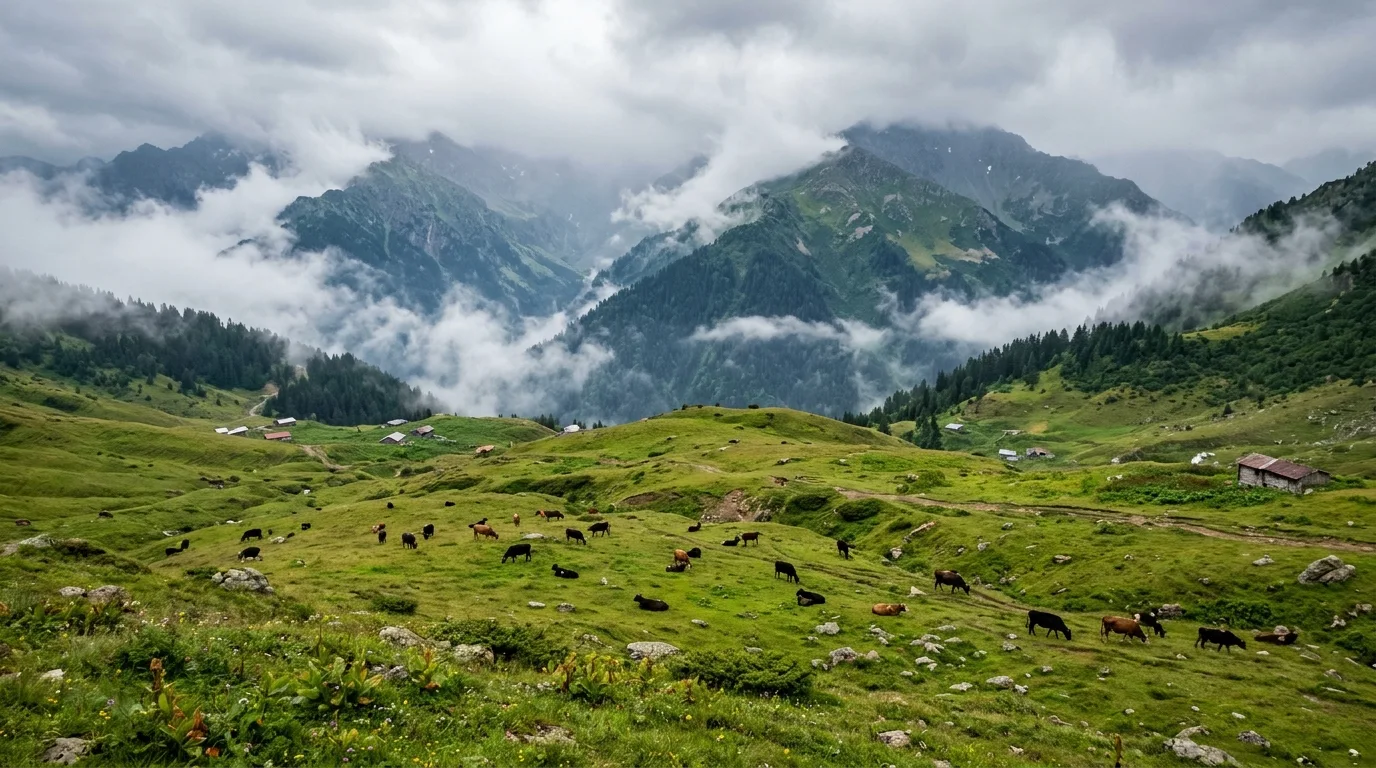
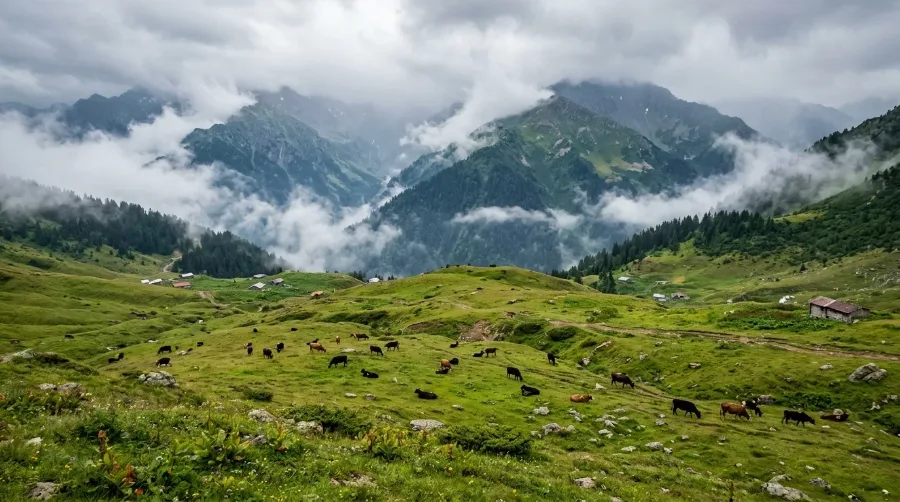
Highland and lake areas. Wikipedia lists Abant, Kartalkaya, Yedigöller, Gölcük and Akçakoca as tourist areas, and pictures Kardüz Yaylası. These are named only briefly.
Harbour lighthouse. A harbour light at the end of the Akçakoca breakwater, with views over the town.
Getting around
Wikivoyage says buses and dolmuş minibuses connect Akçakoca’s downtown area, the bus station and outlying districts. The sources do not describe local transport inside Düzce city or to the highland areas.
Practical tips for visitors
- Wear stout footwear in Fakıllı Cave, according to Wikivoyage.
- The Akçakoca bus station’s facilities are seldom open, so the dolmuş ride downtown may be included in an intercity ticket; ask when booking.
- Wikivoyage says the old town of Akçakoca no longer exists, with only a few dilapidated Ottoman houses left.
- Cafes may serve alcohol, but there is no free-standing bar.
- Mobile coverage: 4G from all Turkish carriers is reported in Akçakoca.
- The provincial official site could not be reached when checking, so confirm opening arrangements locally.
- Plate code
- 81
